The Anaplan pipeline map
Every promotion in your Anaplan landscape, where it came from, where it went, and what authorized it.
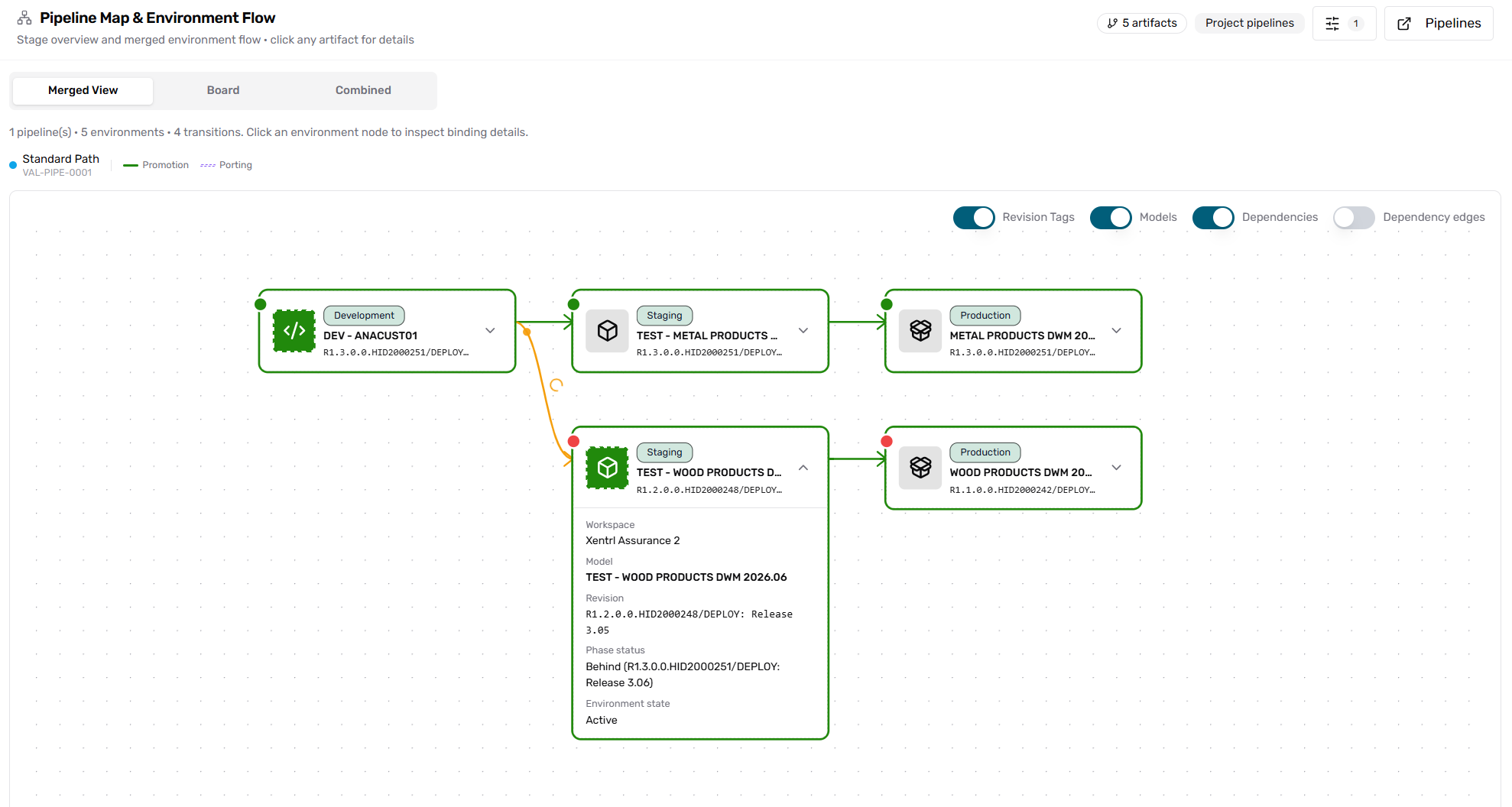
What you are looking at
A promotion path of the kind common in a multi-entity landscape. A shared development environment feeding several test environments, each feeding its own production environment, with a version targeted across all of them.
Every line is a promotion, or a deployment if that is the term your team uses. Every promotion is a point where authorization either exists and is attached to the change, or exists somewhere else, or does not exist.
Why the count matters
An organization running eight or twelve governed models across four environments is managing dozens of promotions per release cycle. Each one needs its own authorization, its own testing evidence, and its own confirmation of result.
Where that checking is done by people, it is done once per promotion, not once per release. That is where the effort goes, and it is why the record has to be reconstructed later rather than retrieved.
What every line on this map carries
A promotion here is not a movement of metadata with a timestamp on it. Each one arrives with the things that make it answerable later.
Authorization, attached
- Approved to be scheduled, then approved to be initiated
- Requester, approver, and executor recorded as distinct roles
- The approval bound to this promotion, not filed near it
Content and state
- The revision tag, carrying the work items it was raised for
- The comparison made before it moved, retained
- The backup taken of the target, and who took it
- Every step in the sequence, timestamped, with the user who performed it
A year later, the question of what this line was and who allowed it is a retrieval.
Three states a governed landscape holds
Authorization attached to the change
The approval exists before the change and travels with it.
Nothing reaching production outside the path
Changes that arrived another way are identified within minutes and put in front of someone who can determine whether they were intended.
What was approved is what is running
The running state is compared against the approved baseline, and the comparison leaves its own record.
Was What's Running Approved?
Why the authorization and the approved state have to sit outside the platform they describe, what conventional software architecture settled on over three decades, and what that means for an Anaplan landscape under audit.
Read the paper